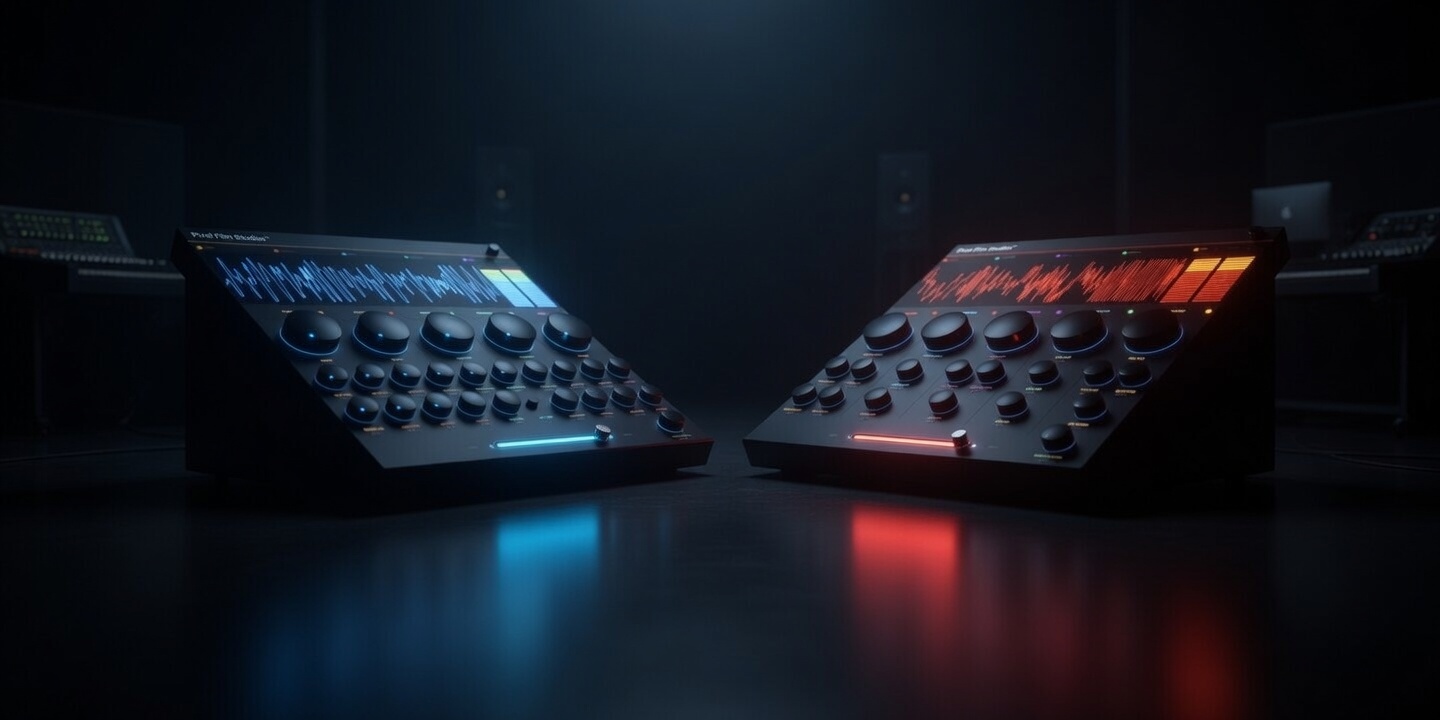
Pixel Film Studios today introduces Lo-Fi Suite and Lo-Fi Digital — two native Audio Unit plugins for Final Cut Pro, sold together as a single purchase. Lo-Fi Suite runs audio through five analog degradation sections: Vinyl, Cassette, Radio, Telephone, and Room. Lo-Fi Digital applies five digital destruction tools: Bit Crusher, Sample Rate Reducer, Wavefolder, Zero Crossing Glitch, and Ring Modulator. In both plugins, every section is draggable. The signal chain reorders in real time. Each plugin has 120 possible processing configurations. Both include a live 60fps oscilloscope. Neither requires a subscription.
Clean audio is forgettable. The records people still listen to, the beats people still replay — they carry the mark of a medium. The snap of a needle. The saturation of a cassette head. The quantization noise of early digital samplers. Imperfection is what makes sound feel real, feel present, feel human. Lo-Fi Suite and Lo-Fi Digital give editors and producers that imperfection, with complete surgical control over exactly how broken things sound — including control over what order the damage happens in, which changes everything.
The Defining Feature: Drag to Reorder the Signal Chain
Most multi-stage audio plugins give you a fixed processing order. The developer decided the chain; you get what they decided. Lo-Fi Suite and Lo-Fi Digital break that convention. Every section in both plugins is draggable — click any section header, drag it up or down, and the sections animate out of the way to show where it will land. Drop it. The processing chain updates immediately with no audio dropout.
The order of sections is itself a creative parameter, not a detail. Put Bit Crusher before Ring Modulator and the ring modulation processes already-quantized, harmonically degraded audio. Flip them and the ring modulator creates new sideband frequencies from the clean input, which the Bit Crusher then quantizes — a completely different result from the same two sections at the same settings. In Lo-Fi Suite, running Vinyl before Cassette simulates dubbing a record to tape. Running Cassette before Vinyl means pressing a cassette mix to vinyl — the tape compression and hiss become the source material the needle then reads. These are not subtle differences.
With five sections and 120 possible orderings per plugin, each is effectively 120 different plugins inside one.
Lo-Fi Digital: Five Tools of Digital Destruction
Lo-Fi Digital focuses on the artifacts of digital hardware — the specific sounds produced by bit reduction, sample rate manipulation, wavefolding distortion, glitch events, and ring modulation. If the sonic territory is old samplers, early digital hardware, corrupted media, or experimental electronic music, this is the tool for it.
- Bit Crusher — reduces bit depth from 16 bits down to 1. At 12 bits: SP-1200 grain. At 8 bits: Game Boy crunch. At 1 bit: a square wave approximation of whatever you put in. Dither softens the quantization edges; Noise Shaping sculpts where the distortion energy concentrates in the frequency spectrum.
- Sample Rate Reducer — drops the sample rate so aliasing artifacts fold back into the audible range as inharmonic noise and tonal artifacts. The AA Filter controls how much aliasing actually passes through. Interpolation determines how the gaps between retained samples get reconstructed — zero-order hold for maximum hardware authenticity, smooth interpolation for a warmer vintage texture.
- Wavefolder — instead of clipping a signal that exceeds a threshold, folds it back on itself. Drive controls how hard the input hits the fold point. Stages (1x to 5x) multiplies the folding — at 5 stages with high drive, a simple input contains dozens of new harmonics. Symmetry and Bias shift the fold character from hollow and odd-harmonic to rich, complex, and asymmetric.
- Zero Crossing Glitch — intercepts the moment a waveform crosses zero and does something wrong with it. Glitch Amount sets frequency. Hold sets duration from percussive clicks to extended stutters. Pitch introduces intonation artifacts — the sound of a sampler losing clock sync or a buffer overflowing mid-playback.
- Ring Modulator — multiplies the input signal against a carrier oscillator (Sine, Sawtooth, or Square) at any frequency from 1 Hz to 2000 Hz. At low frequencies: tremolo. At mid frequencies: metallic pitchy tones that interact with the source harmonics. At high frequencies: inharmonic sideband clusters. Stereo spread widens the effect across the field.
Lo-Fi Suite: Five Worlds of Analog Decay
Lo-Fi Suite models analog playback media — the actual physical mechanisms that produce degradation in each medium, not a stylized approximation of the sound.
- Vinyl — the complete vinyl playback chain: surface noise and groove Wear, slow Wow pitch drift, fast Flutter speed instability, stochastic Crackle, and a real RIAA equalization curve — the actual sound of a needle reading a groove through a phono preamp. Speed control shifts playback pitch and rate. RIAA EQ toggles the phonographic equalization curve on or off.
- Cassette — magnetic tape physics: Bias adjusts the tape magnetization, shifting tone and saturation from bright and harsh (under-biased) to warm and rolled-off (over-biased). Hiss adds the broadband magnetic noise floor. Azimuth misaligns the tape head for high-frequency smear and stereo phase cancellation. Dropout introduces momentary signal losses. Noise Gate shapes the hiss envelope — the sound of Dolby noise reduction systems working imperfectly.
- Radio — broadcast transmission constraints: Bandwidth narrows the frequency range from full to narrow-band midrange. Compress adds aggressive broadcast-processor dynamic squashing. Interference adds static and signal instability. Tune drifts reception off center frequency. AM/FM Mode toggle switches between the narrow, mono, interference-heavy character of AM and the wider, stereo, compression-heavy character of FM.
- Telephone — the switched telephone network's 300–3400 Hz bandpass. Lo Cut sets the high-pass rolloff frequency from 100 Hz to 800 Hz. Rolloff attenuates highs. Crunch adds saturation from overloaded switching equipment. Line Noise adds 60 Hz hum and static. Clip pushes the line into hard distortion — the sound of a connection pushed past its limits.
- Room — not a reverb but a physical space with character. Spring simulates spring reverb tanks: bright, metallic, slightly chaotic — the sound of a vintage guitar amp or organ cabinet. Size scales perceived room volume. Decay sets the tail length. Rattle adds mechanical sympathetic resonances, the kind that come from objects on shelves that vibrate when the bass hits. Diffuse controls reflection density from sparse and echoey to dense and fabric-like.
"Lo-fi production has always been about the character of a medium — the specific way vinyl wears, tape saturates, early samplers quantize. Those textures are what make a beat feel lived-in and present. Lo-Fi Suite gives editors and producers that character with complete control — including control over the order the processing happens in, which is a creative variable most plugins don't even expose. Put vinyl before cassette and you're dubbing a record to tape. Flip them and you're pressing a cassette to vinyl. Same two sections, completely different sound."
— Dave Austin, Founder & CEO, Pixel Film Studios
The Oscilloscope
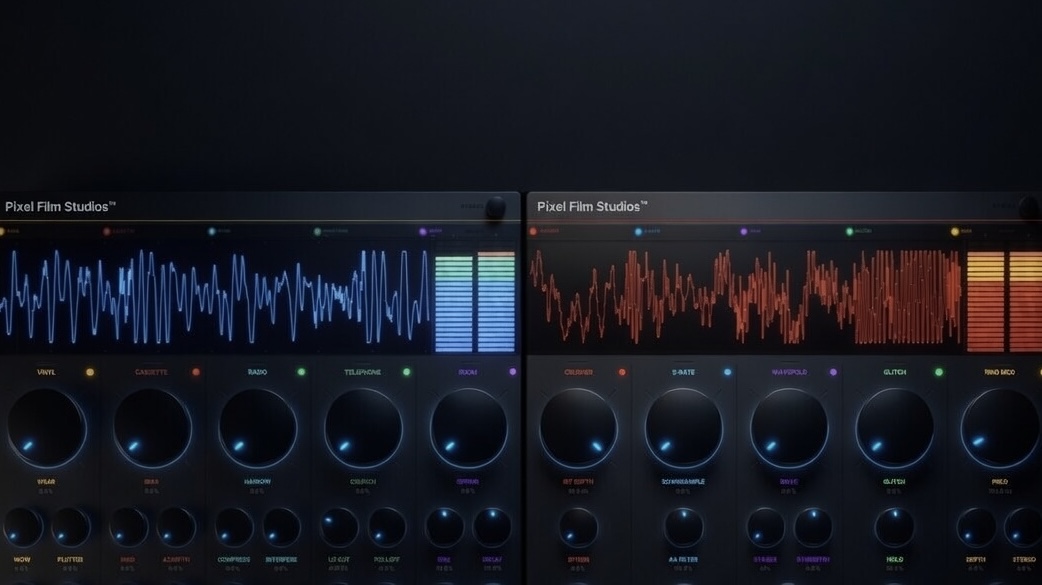
At the top of each plugin runs a real-time waveform display at 60 frames per second. The two plugins have distinct visual characters that match their sonic identities — this is not decorative.
Lo-Fi Digital uses a crisp, clean digital display — sharp lines and hard edges, like a hardware test instrument. Bit-crushed quantization steps are immediately visible as staircase patterns in the waveform. Ring mod sidebands reshape the trace into geometric forms. Wavefolder folds produce visible kinks in the waveform at the fold points.
Lo-Fi Suite uses a CRT phosphor glow aesthetic — the trace has warmth and persistence, like a vintage oscilloscope with a P31 green phosphor screen. Watch vinyl Wow pitch-drift the trace live. See Cassette's tape saturation flatten the peaks. Each active section shows a per-section activity indicator that lights up when signal is passing through it and that section is doing something audible. Stereo LED output meters show post-processing level at all times.
18 Presets Across Both Plugins
Lo-Fi Digital ships with 8 presets: Default, SP-1200 (12-bit, 26 kHz — the E-mu sampler that defined hip-hop production), Game Boy (8-bit DMG crunch), Corrupted File (ZC Glitch and S-Rate for data-loss artifacts), Metallic Sheen (Wavefolder + Ring Mod), Robot Voice (Ring Mod at speech frequencies), Digital Decay (progressive resolution loss across the chain), and Destroyed (maximum settings, blend with Mix to taste).
Lo-Fi Suite ships with 10 presets: Default, 60s Vinyl (warm, worn, slightly drifting — a thrift store 45), C60 Cassette (the mixtape sound — the one Lo-Fi Hip-Hop made iconic), AM Radio (late-night signal from 300 miles away), FM Radio (daytime broadcast through a car stereo), Old Telephone (circa 1970, band-limited and saturated), Lo-Fi Hip-Hop (Vinyl + Cassette + Room — the genre, bottled), Radio Drama (AM compression + spring reverb — 1940s broadcast staging), Vintage Tape (Cassette Bias warmth with Flutter, the reel-to-reel studio character), and Destroyed.
Shared Features
Both plugins include a Master Wet/Dry Mix control that blends the processed signal with the unprocessed original — enabling extreme settings to be dialed back to taste without adjusting individual sections. Master Gain runs from -6 dB to +24 dB for compensating level changes introduced by heavy processing. A single-click Bypass toggle enables instant A/B comparison against the unprocessed signal. Every section has an independent enable toggle — disabled sections dim visually, are removed from the processing chain, and consume zero CPU.
Native Audio Unit — Inside Final Cut Pro
Lo-Fi Suite and Lo-Fi Digital are native AUv3 Audio Units. They appear in the Final Cut Pro effects browser under Audio, alongside Apple's built-in effects. Drag either plugin onto a clip — or select a clip and double-click the effect — and it opens in the inspector immediately. No external application, no routing, no export-reimport. Processing is real-time and non-destructive. Universal binary: native Apple Silicon and Intel.
Availability and Pricing
Lo-Fi Suite and Lo-Fi Digital are available today at pixelfilmstudios.com for $39.95 — both plugins included in a single purchase. One-time, no subscription. Requires macOS Sequoia 15.0 or later and Final Cut Pro 10.8 or later. Compatible with Apple Silicon and Intel. Installs via the PFS Installer app or by manual download from the customer account page.
About Pixel Film Studios
Founded in 2011, Pixel Film Studios is the leading developer of professional visual effects, titles, transitions, and generators built exclusively for Apple Final Cut Pro and Motion. Over the past 14 years, the company has shipped more than 2,000 products and fulfilled millions of orders for video editors, content creators, broadcast designers, and post-production professionals in over 100 countries. Learn more at pixelfilmstudios.com.
Press Contact
Colin Bauer
Director of Communications, Pixel Film Studios
[email protected]