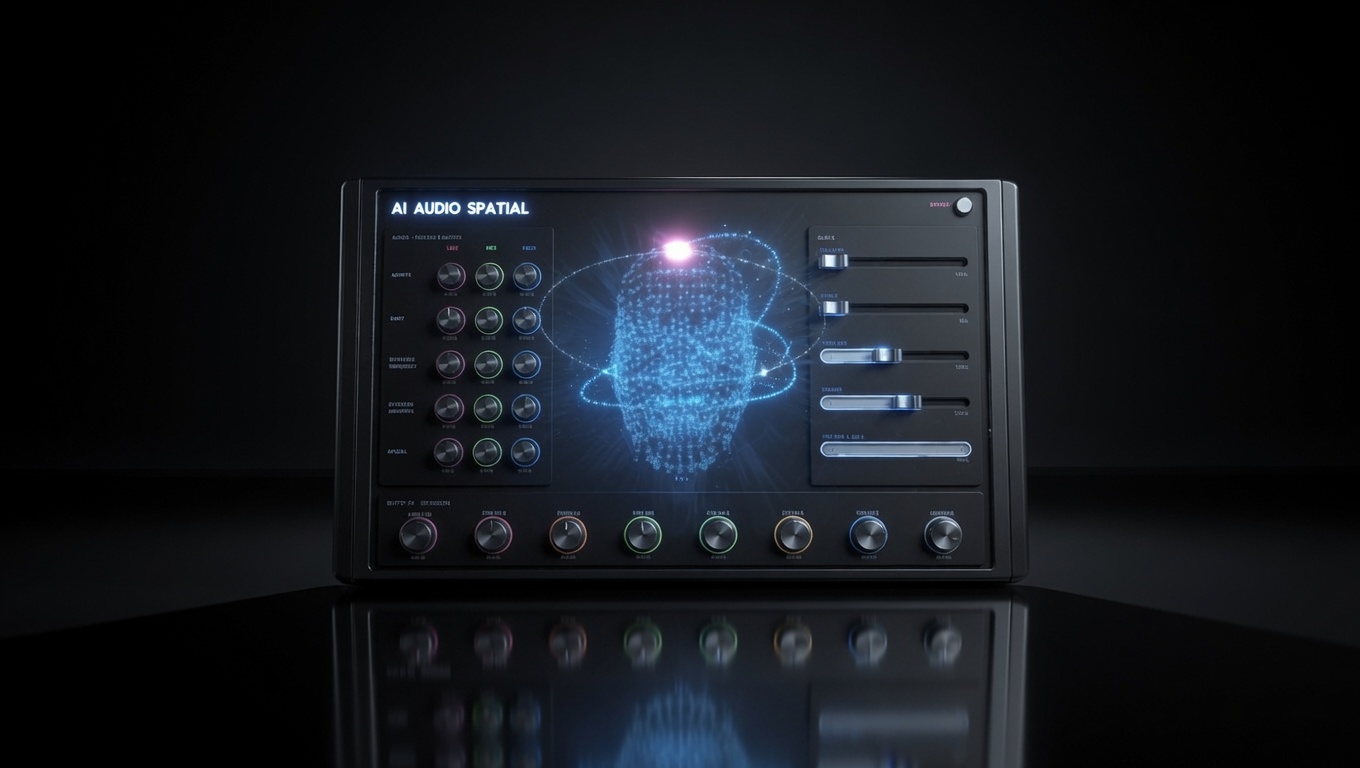
Pixel Film Studios today introduces AI Audio Spatial — the first truly multiband 3D binaural panner for Final Cut Pro. Split any audio into Low, Mid, and High frequency bands and position each one independently anywhere in three-dimensional space: azimuth around the head, elevation above and below, distance from intimate to distant. Binaural head-related transfer function modeling recreates the way human hearing localizes sound in a physical environment — the timing differences between ears, the level differences, and the subtle tonal shaping that the pinna and skull introduce when sound arrives from different angles. A global distance engine simulates air-absorption as sounds recede. Room size and head size controls shape the acoustic context. A post-spatial Output EQ shapes the final blend. Sound that lives in three dimensions, inside Final Cut Pro. $39.95.
Stereo panning — moving a sound left or right on a two-dimensional axis — was the spatial toolkit that Final Cut Pro editors had. It is a tool built for a world of two speakers on a desktop, and it shows. Binaural audio is different: it encodes three-dimensional position cues into a standard stereo signal using the same psychoacoustic mechanisms the human auditory system already uses to locate sounds in the physical world. Played back on headphones or speakers, a correctly encoded binaural signal places sound above, behind, in front, or at any distance — not as an effect, but as a spatial perception that the listener's auditory cortex resolves automatically. AI Audio Spatial brings that capability into Final Cut Pro for the first time, and extends it further: three independent frequency bands mean the bass, midrange, and high frequencies of a single sound can each occupy a different position in space.
Three Bands. Three Worlds.
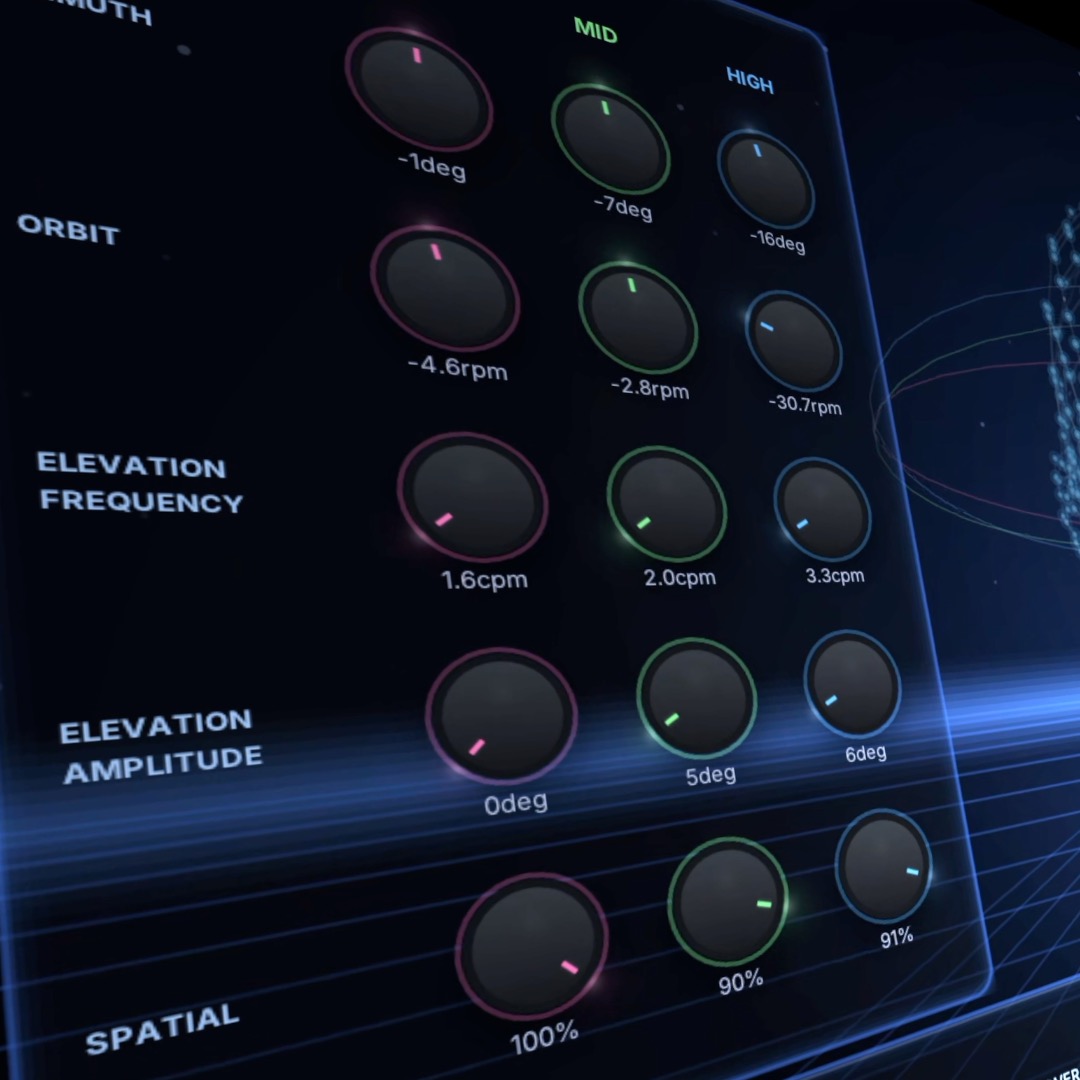
The core of AI Audio Spatial is a three-way frequency splitter that separates the incoming audio into Low, Mid, and High bands before applying any spatial processing. Each band then receives its own independent three-dimensional position: Azimuth sets the angle around the horizontal plane (in front, to the left, behind, to the right), Elevation sets the vertical angle (level with the listener, above, below), and Distance sets how far away the sound appears to be.
The ability to position each band independently changes what spatial audio can do in a mix. Bass frequencies are non-directional in the physical world — the low-frequency content of a sound provides very little localization information to the auditory system, and listeners expect bass to feel centered and stable. With AI Audio Spatial, the Low band can be locked dead-center while the Mid and High bands orbit, shimmer, and move through the spatial field. A voice can sit directly in front while its reverb tail rises above and recedes behind. A music bed can wrap around the listener while dialogue stays anchored at center. These are spatial placements that a single-band panner cannot produce — because a single-band panner can only move everything at once.
Binaural HRTF: How the Brain Hears Where Sound Comes From
Binaural audio works because human hearing uses three physical cues to locate sounds in three-dimensional space — and AI Audio Spatial models all three.
The first cue is interaural time difference: sound arriving from the left reaches the left ear slightly before it reaches the right. The auditory system detects delays as small as 10 microseconds and uses them to resolve the horizontal position of a source. The second cue is interaural level difference: the head creates an acoustic shadow that attenuates the signal reaching the far ear, with the amount of attenuation depending on the frequency and angle of the source. Together these two cues define horizontal position on the azimuth plane.
The third cue — the one that enables elevation perception and front-back disambiguation — is the head-related transfer function (HRTF): the frequency-dependent filtering that the pinna, ear canal, head, and shoulders introduce as sound arrives from different angles. Sound arriving from above is filtered differently than sound arriving from below. Sound from directly in front produces a different spectral signature than sound from directly behind. The auditory system has learned these signatures through a lifetime of experience and uses them to decode elevation and front-back position from a standard stereo signal. AI Audio Spatial applies HRTF modeling per band, independently, so each frequency region of the audio carries its own spatially encoded position cues.
Distance: From Intimate to Down the Hall
Physical distance changes how sound sounds. A source close to the listener is bright, direct, and present. As a source moves away, several things happen simultaneously: the overall level drops, high frequencies attenuate faster than low frequencies because air absorbs treble energy over distance, early reflections from the room surfaces become more prominent relative to the direct sound, and the reverb tail lengthens as the room's acoustic signature dominates the perception.
AI Audio Spatial models all of this. Pull a sound back and it does not just get quieter — it gets further away. High-frequency air absorption darkens the tone as distance increases. Room reflections bloom around the receding source. Push a sound close and it becomes intimate and immediate. The Distance parameter does not replicate the flat, single-dimension result of a level fader — it replicates the perceptual and acoustic experience of a source moving through a physical space.

Global Controls and Output EQ
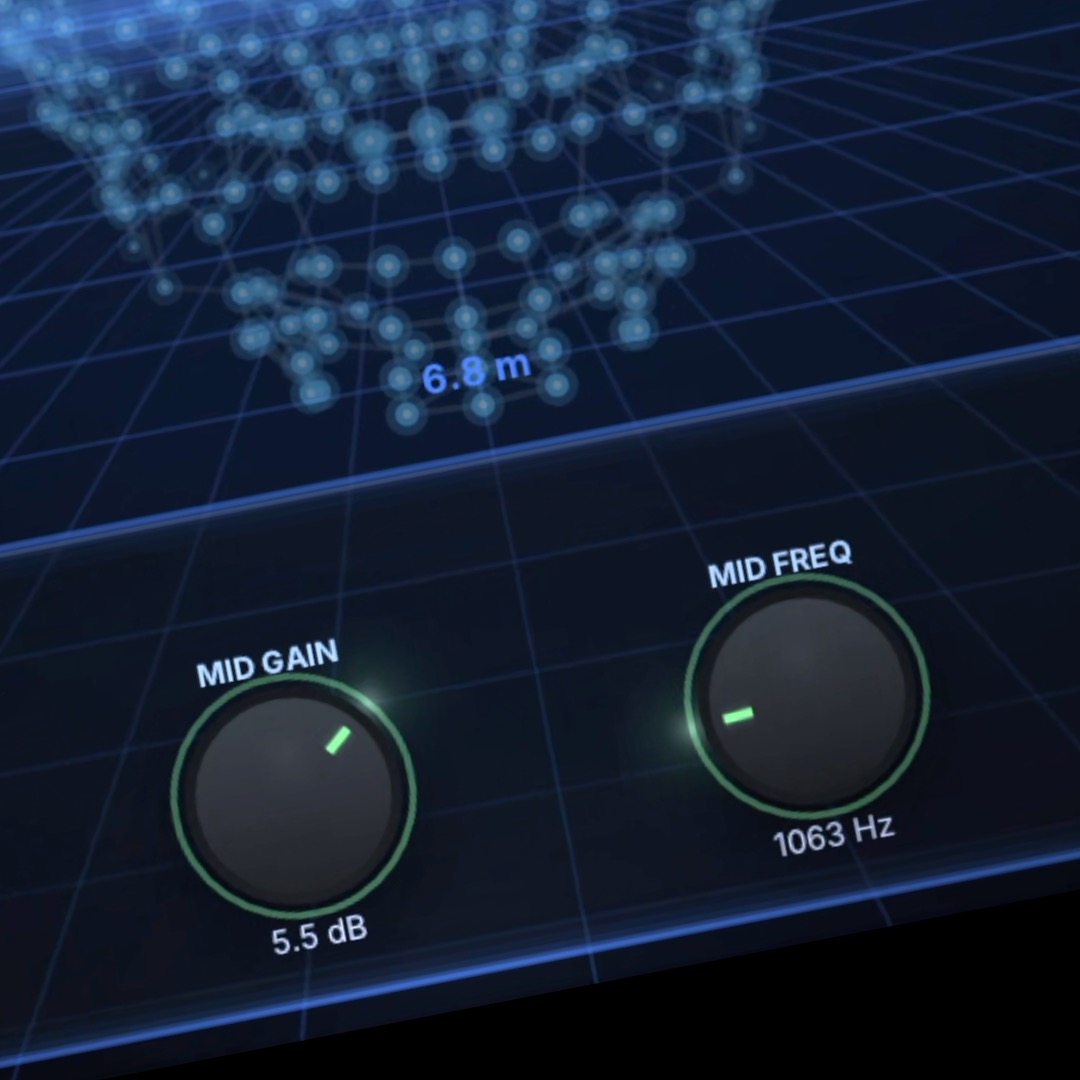
Global controls sit above the per-band settings and shape the acoustic environment that all three bands share. Room Size adjusts the size of the virtual space that the binaural model places the listener inside — a small room produces tight, dense early reflections; a large room produces a spacious, reverberant environment. Head Size adjusts the HRTF model to the listener's head geometry, tuning the timing and level differences for accuracy. Output Level controls the master gain of the processed signal. A global Blend control mixes between the fully processed binaural output and the unprocessed dry signal, allowing the effect to be dialed in from subtle spatial enhancement to full immersive placement.
A post-spatial Output EQ with dedicated Low, Mid, and High frequency controls shapes the tonal character of the final blended output. Because it sits after the spatial processing and the blend stage, the Output EQ adjusts the sound that the listener actually hears — the fully spatialized, blended result — rather than the input to the spatial engine. This placement ensures that tonal adjustments don't disturb the spatial encoding itself.
"Flat stereo is a box. Everything in it lives on the same two-dimensional plane — left, center, right, and that's the entire vocabulary. AI Audio Spatial is the room. Three frequency bands, each with its own azimuth, elevation, and distance. The bass stays where bass belongs: centered, stable, grounded. The mids and highs breathe and move and live in space the way they do in a real acoustic environment. It's a fundamentally different way to think about where sound lives in a mix."
— Dave Austin, Founder & CEO, Pixel Film Studios
Availability and Pricing
AI Audio Spatial is available today at pixelfilmstudios.com for $39.95. One-time purchase, no subscription. Requires macOS Ventura 13.0 or later and Final Cut Pro 10.8 or later. Universal binary — native Apple Silicon and Intel. Installs via the PFS Installer app or by manual download from the customer account page.
About Pixel Film Studios
Founded in 2011, Pixel Film Studios is the leading developer of professional visual effects, titles, transitions, and generators built exclusively for Apple Final Cut Pro and Motion. Over the past 14 years, the company has shipped more than 2,000 products and fulfilled millions of orders for video editors, content creators, broadcast designers, and post-production professionals in over 100 countries. Learn more at pixelfilmstudios.com.
Press Contact
Colin Bauer
Director of Communications, Pixel Film Studios
[email protected]